Medical Coding Terminology: 100 Key Roots, Prefixes and Suffixes (CPC Exam)
By CPCPrep Team ·
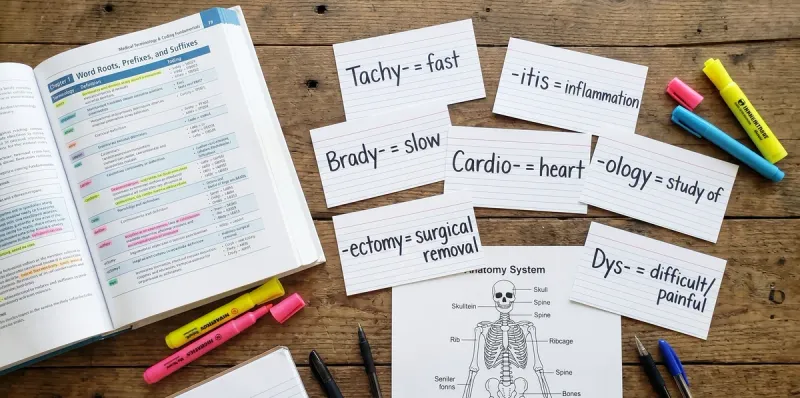
Medical Coding Terminology: 100 Key Roots, Prefixes and Suffixes for the CPC Exam
You can memorize every ICD-10 guideline and still miss questions if you misread the operative report. That’s what makes terminology the hidden variable. Nobody drills you on it directly. It determines whether you understand what the physician actually documented.
For strategy on the full exam, see the CPC Exam Study Strategy.
Why medical terminology matters more than you think
Let’s be real about this: the CPC exam doesn’t have a “terminology section.” It tests terminology inside every other section. When you’re decoding a surgical note, identifying the correct procedure code depends entirely on whether you understood what the surgeon described. Get the suffix wrong, and you’re coding a repair when the note says a removal.
Working fluency is the goal, not memorization. You need to see “cholecystectomy” and immediately know that’s gallbladder removal. Not gallbladder examination, not gallbladder repair. Same root, different suffix, totally different code range.
The exam is open-book. That helps. But recognition speed still matters. If you’re stopping to decode every third word in a scenario, you’re losing time.
How the CPC exam tests terminology
Here is what actually happens during the exam: you read a clinical note, you match it to a CPT or ICD-10 code, and the answer hinges on whether you understood one or two key terms. They don’t ask “define nephrostomy.” They ask you to code a nephrostomy and put four similar-looking codes as answer choices.
The traps are usually in the suffixes. An -ectomy is removal. An -otomy is cutting into. An -ostomy is creating an opening. Three different suffixes, three completely different procedures, sometimes in the same code section.
answer all the medical terminology first: those are points you can get fast. Identify the body system, identify the procedure type, then narrow to the code. That’s the workflow.
Prefixes: the 25 most common
| Prefix | Meaning | Example |
|---|---|---|
| a-, an- | without, not | anemia (without blood), apnea (without breathing) |
| brady- | slow | bradycardia |
| tachy- | fast | tachycardia |
| hyper- | above, excessive | hypertension |
| hypo- | below, deficient | hypothyroidism |
| peri- | around | pericarditis |
| endo- | within, inside | endoscopy |
| exo- | outside | exocrine |
| sub- | below | subcutaneous |
| supra- | above | suprarenal |
| inter- | between | intervertebral |
| intra- | within | intravenous |
| trans- | across, through | transdermal |
| poly- | many | polyuria |
| oligo- | few, little | oliguria |
| bi- | two | bilateral |
| uni- | one | unilateral |
| hemi- | half | hemiplegia |
| macro- | large | macrocephaly |
| micro- | small | microscope |
| neo- | new | neoplasm |
| pre- | before | prenatal |
| post- | after | postoperative |
| anti- | against | antibiotic |
| auto- | self | autograft |
A few of these cause consistent problems on the exam. Intra- (within) vs inter- (between) is a classic. An intraarticular injection goes inside the joint. An intervertebral disc sits between vertebrae. Different prefixes, different anatomy, different codes.
Suffixes: the 25 most important
| Suffix | Meaning | Example |
|---|---|---|
| -itis | inflammation | appendicitis |
| -ectomy | surgical removal | appendectomy |
| -ostomy | creating an opening | colostomy |
| -otomy | cutting into | laparotomy |
| -plasty | surgical repair | rhinoplasty |
| -scopy | visual examination | colonoscopy |
| -graphy | process of recording | radiography |
| -gram | record, image | electrocardiogram |
| -algia | pain | neuralgia |
| -dynia | pain | cardiodynia |
| -pathy | disease | neuropathy |
| -osis | condition, abnormal state | fibrosis |
| -emia | blood condition | anemia |
| -uria | urine condition | hematuria |
| -megaly | enlargement | splenomegaly |
| -stenosis | narrowing | aortic stenosis |
| -lysis | destruction, breaking down | hemolysis |
| -genesis | origin, production | carcinogenesis |
| -rrhea | flow, discharge | diarrhea |
| -rrhage | bursting forth | hemorrhage |
| -rraphy | suturing | herniorrhaphy |
| -pexy | fixation, suspension | nephropexy |
| -centesis | surgical puncture | thoracentesis |
| -cele | hernia, protrusion | rectocele |
| -phobia | fear | claustrophobia |
The -ectomy/-ostomy/-otomy cluster is where candidates lose the most points. Colostomy creates an opening in the colon. Colotomy cuts into the colon. Colectomy removes part of the colon. Three different procedures, all in the same body system, coded in very different ranges in CPT.
And guess what: the surgery section of CPT is organized by body system, so these distinctions determine which subsection you even search in.
Body system roots: 50 by system
Cardiovascular
| Root | Meaning | Clinical example |
|---|---|---|
| cardi/o | heart | cardiomegaly, cardiology |
| angi/o | vessel | angioplasty, angiogram |
| phleb/o | vein | phlebotomy |
| arteri/o | artery | arteriosclerosis |
| hem/o, hemat/o | blood | hematoma, hemorrhage |
Respiratory
| Root | Meaning | Clinical example |
|---|---|---|
| pneum/o, pulmon/o | lung | pneumonia, pulmonary embolism |
| bronch/o | bronchus | bronchoscopy |
| rhin/o | nose | rhinoplasty |
| trache/o | trachea | tracheotomy |
| laryng/o | larynx | laryngoscopy |
| pector/o | chest | pectoralis muscle |
Musculoskeletal
| Root | Meaning | Clinical example |
|---|---|---|
| oste/o | bone | osteoporosis, osteotomy |
| arthr/o | joint | arthroscopy, arthritis |
| my/o, myos/o | muscle | myopathy, myositis |
| tend/o | tendon | tendonitis |
| chondr/o | cartilage | chondroplasty |
| cost/o | rib | costochondritis |
| vertebr/o | vertebra | vertebroplasty |
Digestive
| Root | Meaning | Clinical example |
|---|---|---|
| gastr/o | stomach | gastroscopy, gastrectomy |
| enter/o | intestines | enteritis |
| col/o, colon/o | colon | colostomy, colonoscopy |
| hepat/o | liver | hepatitis, hepatomegaly |
| cholecyst/o | gallbladder | cholecystectomy |
| pancreat/o | pancreas | pancreatitis |
| proct/o | rectum | proctoscopy |
| esophag/o | esophagus | esophagectomy |
Urinary and renal
| Root | Meaning | Clinical example |
|---|---|---|
| nephr/o, ren/o | kidney | nephrostomy, renal failure |
| ureter/o | ureter | ureteroplasty |
| cyst/o | bladder | cystoscopy |
| urethr/o | urethra | urethroplasty |
| pyel/o | renal pelvis | pyelonephritis |
Nervous system
| Root | Meaning | Clinical example |
|---|---|---|
| neur/o | nerve | neuralgia, neuropathy |
| encephal/o | brain | encephalopathy |
| myel/o | spinal cord / bone marrow | myelopathy |
| cerebr/o | cerebrum | cerebrovascular |
| mening/o | meninges | meningitis |
| psych/o | mind | psychiatry |
Integumentary
| Root | Meaning | Clinical example |
|---|---|---|
| derm/o, dermat/o | skin | dermatitis, dermatology |
| kerat/o | hard tissue | keratoplasty |
| melan/o | black / pigment | melanoma |
| onych/o | nail | onychomycosis |
| trich/o | hair | trichotillomania |
Endocrine
| Root | Meaning | Clinical example |
|---|---|---|
| thyr/o, thyroid/o | thyroid | thyroidectomy, thyrotoxicosis |
| adren/o | adrenal | adrenalectomy |
| pancreat/o | pancreas | pancreatitis (also digestive) |
| gonad/o | gonads | gonadotropin |
How to study these efficiently
Here’s where it gets practical: Don’t try to memorize all 100 at once. Cluster by body system. Study the cardiovascular cluster before doing E/M or cardiac surgery questions. Study the musculoskeletal cluster before orthopedic coding practice. Context makes the terms stick faster than flash cards alone.
The approach that works: pick a body system, learn its roots and common procedures, then immediately do 10-15 coding questions in that system. By the time you see “cholecystectomy” in a scenario, you’ve already decoded it three times during practice.
focus on the guidelines in the actual CPT book, including the intro and the guidelines before each section. Those sections often use terminology you need to know to apply the code correctly. Reading guidelines in context reinforces terminology better than a standalone drill.
The Blitz mode in CPCPrep is built for this workflow. 10 terms at a time, spaced repetition, tied to body system clusters. You don’t grind through all 100 in one sitting. You hit the cardiovascular set before cardiac surgery practice, then the respiratory set before pulmonology. The terms land in context, not in a vacuum.
Sources
- NLM Medical Subject Headings (MeSH)
- MedlinePlus medical terminology resources
- AAPC CPC exam content outline
Practice terminology in Blitz mode: 10 terms, 60 seconds.
Related: CPC Exam Prep Guide | CPC Exam Study Strategy | CPC Practice Test | Medical Coding Career Change Guide | Can You Code Without a Medical Background?
Sources & References
Frequently Asked Questions
Do I need to memorize all medical terminology for the CPC exam? ▼
You need working fluency, not memorization of every term. Focus on the 100 most common roots, prefixes, and suffixes organized by body system. The CPC exam is open-book, so you can look up unfamiliar terms: but recognition speed matters. If you're pausing to decode basic roots in every question, you will run out of time.
What terminology is most heavily tested on the CPC exam? ▼
Cardiovascular, musculoskeletal, respiratory, and integumentary terms appear most frequently. Surgery sections account for a large portion of the exam, so anatomical roots tied to those body systems are the highest priority. Get those clusters solid first.
Is medical terminology tested directly on the CPC exam? ▼
Not usually in a 'define this term' format. Terminology is tested indirectly: you cannot correctly assign a procedure code if you misread the operative report. Understanding roots, prefixes, and suffixes helps you decode clinical documentation faster and choose the right code range immediately.
How long does it take to learn medical terminology? ▼
Most candidates develop working fluency in 4 to 6 weeks of focused study. Daily 10-minute terminology drills are more effective than long cramming sessions. The body-system clustering approach (learning roots alongside relevant practice questions) consistently cuts study time compared to memorizing lists in isolation.
Test Your Knowledge
5 quick questions on this topic.
Related Articles
CPC Exam Body Systems: All 17 Domains Explained (2026 Study Priority Guide)
The CPC exam covers 17 medical coding domains. Here is which body systems carry the most questions, how to prioritize your study time, and what the exam actually tests in each section.

How to Study for the CPC Exam with Kids: Realistic Tips for Busy Parents
You do not need 4-hour study blocks to pass the CPC exam. Here is a realistic study plan built for parents: 15-30 minute sessions, micro-drills, and a 4-month schedule that works.

CPC Mock Exam Guide: How to Use Practice Exams to Pass on Your First Try
Taking a CPC mock exam is not the same as being ready for one. Here is how to run your mock exams to actually prepare: timing, review strategy, score interpretation, and when you are ready.
Ready to practice?
Test your CPC knowledge with real exam-style questions. Free to start.
Start Blitz Mode