How to Study for the CPC Exam: Open-Book Timing Strategy + 12-Week Schedule
By CPCPrep Team ·
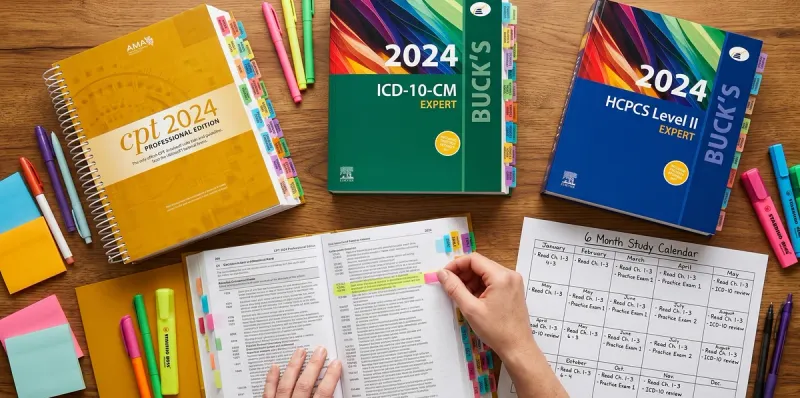
How to Study for the CPC Exam: Open-Book Timing Strategy + 12-Week Schedule
Is the CPC Exam Really Open Book? (What That Means in Practice)
Yes, the exam is fully open-book. You walk in with your CPT, ICD-10-CM, and HCPCS Level II codebooks, tabbed and highlighted however you like. No digital devices, no loose papers.
Here is what “open-book” does not mean: it does not mean you can look everything up from scratch. You have 100 questions and 240 minutes. That works out to 2.4 minutes per question if you treat them all equally. A mini operative report where each answer choice includes four separate codes? That question takes longer than 2.4 minutes. The time has to come from somewhere.
Candidates who approach the exam assuming the open-book format makes it easy walk in with a false sense of security. You need to find codes fast, not discover them. There is a real difference between knowing your way around a codebook and leafing through it hoping something looks right.
The open-book format is an advantage. But only if you have prepared specifically for it.
The Number One Reason Candidates Fail (It Is Not the Rules)
Most candidates who fail the CPC exam know the rules well enough. They have read the CPT guidelines. They understand the ICD-10-CM conventions. They have studied modifiers. And they still run out of time.
Slow book navigation is what actually kills exam performance. Candidates who go in with un-tabbed books lose minutes they cannot afford. Four hours sounds like plenty of time until you are on question 60 and realize you have spent 11 minutes on three complex questions and are already behind pace.
Code book organization is the single biggest time-saver on exam day. Your hand should reach for the right section automatically by exam day. That level of navigation fluency does not come from reading. It comes from hundreds of practice questions with your actual codebooks in hand.
The second mistake is related: drilling questions without a timer. You need to get that timing element in there. Doing questions without a clock is homework, not exam prep. It tells you whether you understand the content but tells you nothing about whether you can execute under exam conditions.
How to Tab and Organize Your Codebooks
Tabbing your codebooks before exam day is not optional. It is the preparation. A well-tabbed set of books turns a 45-second lookup into a 10-second one. Over 100 questions, that adds up to meaningful time saved.
Use color-coded sticky tabs. Different colors for different books or different sections within a book. Buy good-quality tabs that stay put. Replace any that are falling off before exam day.
CPT tabbing strategy by section
Tab the major CPT sections first, then the appendices you will actually use.
Main sections:
- Evaluation and Management (99202-99499)
- Anesthesia (00100-01999)
- Surgery: Integumentary System
- Surgery: Musculoskeletal System
- Surgery: Respiratory System
- Surgery: Cardiovascular System
- Surgery: Digestive System
- Surgery: Urinary System
- Surgery: Male Genital System
- Surgery: Female Genital System
- Surgery: Nervous System
- Surgery: Eye and Ocular Adnexa
- Surgery: Auditory System (Ear)
- Radiology (70010-79999)
- Pathology and Laboratory (80047-89398)
- Medicine (90281-99199)
Appendices worth tabbing:
- Appendix A: Modifier descriptions (you will go here more than you expect)
- Appendix B: Deleted, invalid, and out-of-use codes
- Appendix E: Modifier 51 exempt codes
ICD-10-CM tabbing by chapter
Tab by chapter code range, not by disease name. When a question gives you a diagnosis, your hand goes to the right chapter instantly.
- Chapter 1: A00-B99 (Infectious and Parasitic Diseases)
- Chapter 2: C00-D49 (Neoplasms)
- Chapter 3: D50-D89 (Blood and Blood-Forming Organs)
- Chapter 4: E00-E89 (Endocrine, Nutritional, Metabolic)
- Chapter 5: F01-F99 (Mental and Behavioral)
- Chapter 9: I00-I99 (Circulatory System)
- Chapter 10: J00-J99 (Respiratory System)
- Chapter 13: M00-M99 (Musculoskeletal and Connective Tissue)
- Chapter 15: O00-O9A (Pregnancy, Childbirth, Puerperium)
- Chapter 19: S00-T88 (Injury, Poisoning, Consequences of External Causes)
- Chapter 20: V00-Y99 (External Causes of Morbidity)
Also tab the ICD-10-CM Official Guidelines section and the Table of Neoplasms in the Alphabetic Index. Both come up on the exam.
HCPCS quick-reference tabs
Tab HCPCS by letter range. The exam does not require deep HCPCS knowledge, but when a question involves supplies, drugs, or DME, you need to find the right letter fast.
- A codes: Ambulance and transportation, medical supplies
- B codes: Enteral and parenteral therapy
- C codes: Outpatient PPS
- D codes: Dental procedures
- E codes: DME (durable medical equipment)
- G codes: Procedures and professional services
- J codes: Drugs administered other than oral method
- L codes: Orthotics and prosthetics
- Q codes: Temporary codes
- V codes: Vision and hearing services
When to Start Timing Yourself
Timing yourself too early creates anxiety before you have the rule base to support it. Timing yourself too late means you arrive at exam day without the pacing experience you need. The research-backed window is week 9, after you have built genuine content knowledge.
Weeks 1-8: Rule acquisition, no timer
Use the first eight weeks to build your knowledge base. Read. Drill untimed questions. Look up every code you are unsure about. Do not race. The goal in this phase is accuracy, not speed. You need to build the decision trees that will later run automatically under pressure.
Focus especially on: E/M MDM criteria, ICD-10-CM sequencing guidelines, CPT modifier rules, NCCI bundling logic. These are the domains that require the deepest understanding. Getting them right slowly now means getting them right fast later.
Weeks 9-16: Timed drills at 2.5 min/question
At week 9, add the clock. Start with 15-question sets at 37 minutes (2.5 min/question, giving yourself a small buffer). Review every wrong answer, but also review every question that took more than 3 minutes. Slow questions are a separate problem from wrong answers.
Stop studying passively. If you are reading more than you are coding, flip the ratio. Normally, three timed practice exams is what it takes to get these techniques down to the point where your pace is consistent.
Identify your slow domains and drill those specifically. If operative reports consistently eat your time, do operative report sets exclusively until your speed improves. Do not keep rotating through all domains equally if one domain is dragging your overall pace.
Weeks 17-24: Full 4-hour mock exams
At some point before exam day, you need to sit for a full 100-question, 4-hour simulation. Not a shortened version. The full thing. This is not negotiable.
The reason is physiological as much as intellectual. Sustained concentration for four hours is a skill. Candidates who have never done it find themselves mentally fatigued at the two-hour mark. That fatigue shows up in coding errors and slower lookups. The only way to build that endurance is to practice it.
Simulate real conditions: sit at a desk, use your actual codebooks, do not pause. Score your results by domain and address any gaps in the remaining days before your exam.
12-Week Study Schedule Breakdown
This schedule assumes you are starting with basic medical terminology familiarity. If you are starting from zero, add 4 weeks at the front for anatomy and terminology before week 1 below.
| Week | Focus | Activity |
|---|---|---|
| 1-2 | Anatomy + ICD-10-CM foundations | Review body systems, medical terminology prefixes and suffixes, ICD-10-CM conventions (Excludes1/2, code first, use additional code, sequencing rules) |
| 3-4 | E/M coding | 99202-99499, new vs. established patients, MDM table (straightforward, low, moderate, high), time-based coding rules |
| 5-6 | Surgery: integumentary and musculoskeletal | Excisions, repairs, wound closures, lesion sizing, fracture and joint procedures |
| 7-8 | Modifiers | 25, 51, 59, 57, 22, 52, 53, 79, 80 : untimed drills until rules feel automatic |
| 9 | Start timing | 15-question sets at 37 minutes. Review wrong answers and slow questions separately. |
| 10 | ICD-10-CM sequencing + NCCI bundling | Principal diagnosis selection, add-on codes, mutually exclusive codes, unbundling traps |
| 11 | HCPCS + remaining surgery sections | Respiratory, cardiovascular, digestive, urinary, nervous system, eye, ear |
| 12 | Full mock exam | 100 questions under 4-hour limit. Score by domain. Address weak areas in the 48 hours before exam day. |
This schedule is compressed. AAPC recommends 2 years of hands-on coding experience before attempting the exam. If you are earlier in your training, extend weeks 1-8 and do not rush the rule acquisition phase.
The Blitz, Sniper, and Mock Exam Study Loop
Three study modes build three different skills. Using only one of them is not enough.
Blitz: fast-fire terminology and anatomy (weeks 1-4). Short flashcard-style drills on medical terms, anatomical locations, and code ranges. The goal is building the mental map of where everything lives, both in your body and in your codebook. Fast repetition with immediate feedback builds retention better than slow re-reading.
Sniper: rule dilemma scenarios (weeks 5-11). One scenario at a time, with a full explanation of the right answer and why the other options are wrong. This is where you build decision-making under ambiguity. Real exam questions are often designed to test whether you know the rule behind the code, not just the code itself. Sniper mode is where you train for those questions specifically.
Mock exams: full 4-hour simulation (week 12+). This replicates real exam conditions better than any study guide. All codebooks open. Full 100 questions. Timed. Score by domain. The candidates who pass on the first attempt are almost always the ones who have run at least two or three full mock exams before the real thing.
This loop replicates how actual coders work: quick lookups, applied rules, and sustained execution under time pressure. Each mode builds a different layer of the same skill set.
Ready to put the schedule into practice? Start your timed practice now: free 20-question drill, no account needed.
See also: CPC Exam Prep Guide | CPC Exam Pass Rate | CPC Mock Exam Guide | Best CPC Study Materials
Sources & References
Frequently Asked Questions
Is the CPC exam open book in 2026? ▼
Yes. The CPC exam is fully open-book. You may bring your CPT, ICD-10-CM, and HCPCS Level II codebooks with tabs and highlights. Electronic devices, phones, and loose papers are not allowed. The open-book format is an advantage if you have tabbed your books well and practiced navigating them under time pressure. It is not an advantage if you are looking up every answer from scratch.
How many hours should I study for the CPC exam? ▼
Most candidates need 150-200 hours over 3-6 months. AAPC recommends 2 years of coding experience before attempting, but it is not required. If you have a clinical background or work in medical billing, you may be able to compress the study time. If you are starting without a medical background, plan for the full 6 months.
How do I tab my books for the CPC exam? ▼
Tab CPT by major section: E/M, each Surgery body system, Radiology, Pathology, Medicine, plus key appendices (A, B, E). Tab ICD-10-CM by chapter code range. Tab HCPCS by letter. Use different colors for different books or different functional areas within a book. Your tabs should be placed so you can open directly to any major section within two seconds.
When should I start doing timed practice? ▼
Start timed practice in week 9 of your study plan, after you have built a solid base of rule knowledge. Timing yourself too early creates anxiety without building skills. Timing yourself too late means you arrive at exam day without pacing experience. Week 9 is the right window for most candidates. At that point, you have enough knowledge to be accurate and enough to start training for speed.
What is the best way to study for the CPC exam? ▼
Combine three modes: quick-fire terminology drills (Blitz), scenario-based rule practice (Sniper), and full timed mock exams. Doing only one of these is not enough. Reading study guides without coding practice tells you about the rules but does not build the execution speed the exam requires. Timed drilling without a rule base produces anxiety without improvement. All three modes together, in sequence, is what produces first-attempt passes.
Test Your Knowledge
5 quick questions on this topic.
Related Articles
CPC Exam Body Systems: All 17 Domains Explained (2026 Study Priority Guide)
The CPC exam covers 17 medical coding domains. Here is which body systems carry the most questions, how to prioritize your study time, and what the exam actually tests in each section.
How to Study for the CPC Exam with Kids: Realistic Tips for Busy Parents
You do not need 4-hour study blocks to pass the CPC exam. Here is a realistic study plan built for parents: 15-30 minute sessions, micro-drills, and a 4-month schedule that works.
CPC Mock Exam Guide: How to Use Practice Exams to Pass on Your First Try
Taking a CPC mock exam is not the same as being ready for one. Here is how to run your mock exams to actually prepare: timing, review strategy, score interpretation, and when you are ready.
Ready to practice?
Test your CPC knowledge with real exam-style questions. Free to start.
Start Blitz Mode