Free CPC Practice Test 2026: 20-Question Sample + Full Simulator
By CPCPrep Team ·
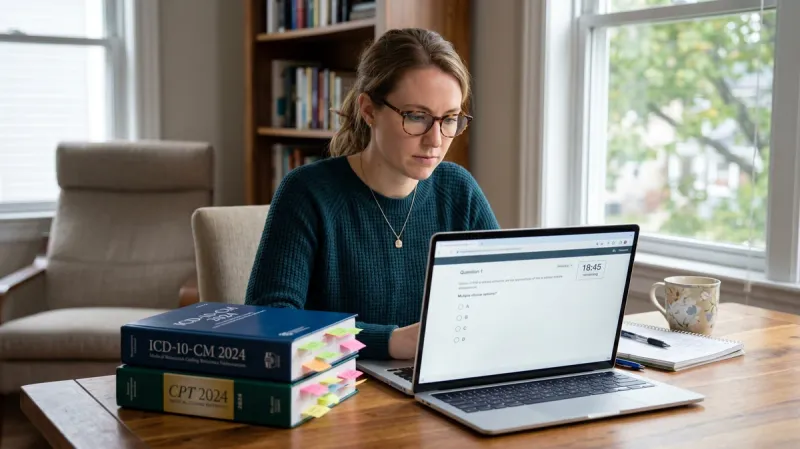
Free CPC Practice Test 2026: 20-Question Sample + Full Simulator
Start the Free 20-Question CPC Practice Test
No account needed. Hit start and the clock begins. You can pause and resume across multiple sessions. Your progress is saved automatically.
What you get in the free test:
- 20 questions drawn from the highest-weight CPC domains
- Per-question explanations after you submit
- Score breakdown by domain so you know where to focus
What the full simulator adds:
- 100 questions mirroring the real exam format
- 4-hour countdown timer
- Domain-level score card at the end
- Pause and resume across days (no other tool does this)
Ready for the full 100-question timed simulator? Start your free CPCPrep trial at cpcprep.com.
What the CPC Exam Covers: 17 Domains You Will Be Tested On
The AAPC publishes an official exam outline at aapc.com/certifications/cpc. Here’s what that actually looks like in practice.
The 17 domains are not weighted equally. Some sections have 3-4 questions. Others have 10+. Knowing the weight distribution is the first step to studying smart, not just studying hard.
Surgery and integumentary (largest section)
Surgery codes, particularly integumentary procedures, make up the biggest slice of the exam. You will see questions on excisions, repairs, adjacent tissue transfers, and wound closures. The trick: read the op note carefully before you touch your codebook. The answer is usually in the documentation.
Integumentary requires you to calculate lesion sizes, understand the difference between simple and intermediate repairs, and know when to add modifiers. It sounds like a lot. With practice, it becomes pattern recognition.
Evaluation and Management (E/M) codes
E/M questions trip up a lot of candidates because the 2021 guidelines changed things significantly. The medical decision-making (MDM) method is now the primary path. Time-based coding is still valid, but you need to know when each applies.
Pay attention to the level of MDM: straightforward, low, moderate, high. Each has specific criteria. One detail off and your code is wrong. Practice these until the criteria feel automatic.
ICD-10-CM diagnosis coding
The exam will give you a clinical scenario and ask you to pick the correct ICD-10-CM code or code sequence. Sequencing matters. Principal diagnosis first, then additional diagnoses, then external cause codes if required.
Common traps: coding the symptom when the confirmed diagnosis is documented, or missing a manifestation code that must be reported together with an underlying condition code. Slow down on these questions.
Modifiers and special circumstances
Modifiers are everywhere on the CPC exam. The most tested: 25, 51, 59, 76, 77, and the NCCI-associated modifiers (XE, XP, XS, XU). You also need to know when a modifier changes reimbursement and when it is informational only.
Here’s what most guides won’t tell you: modifier questions are rarely just about the modifier itself. They’re about understanding the full clinical scenario and whether the second procedure was truly distinct from the first.
How to Read Your Practice Score
A practice score only helps you if you know what to do with it. Here’s the honest answer on what your number actually means.
Score benchmarks by domain
Don’t just look at your total. Look at your domain breakdown. A 72% overall score could hide a 50% in integumentary, which is one of the heaviest sections. That’s a problem.
Target benchmarks before exam day:
- Below 60%: High priority. Stop and rebuild from the foundation in this domain.
- 60-69%: In range but inconsistent. More practice questions, focus on explanations.
- 70-74%: Borderline. On exam day, stress pushes scores down, not up.
- 75%+: You’re in solid territory. Keep it there.
For detailed stats on first-attempt pass rates by domain, see our CPC exam pass rate breakdown.
What score means you are ready
The real exam requires 70%. But practicing to a 70% average is not enough. You need margin.
Aim for 75%+ consistently across at least three full practice tests before you book your exam date. That buffer accounts for test-day nerves, time pressure, and questions in formats you haven’t seen before.
Let’s be real about this: if you’re scoring 68-72% in practice, you are not ready yet. Close, but not ready. Two more weeks of targeted practice on your weak domains can change that.
Free 20-Question Sample vs Full 100-Question Simulator
Here’s what’s actually different between the two, beyond just question count.
| Feature | Free 20-Q | Full Simulator |
|---|---|---|
| Questions | 20 | 100 |
| Timer | No | Yes (4-hour countdown) |
| Per-question explanations | Yes | Yes |
| Domain score breakdown | Basic | Detailed |
| Pause and resume | Yes | Yes, multi-day |
| Account required | No | Yes (free account) |
Most free practice tests online (Mometrix, Medical Coding Ace, others) do not support pausing mid-exam across days. If you’re studying in short windows during lunch breaks or after kids go to bed, that matters. CPCPrep saves your place automatically.
Also: CPCPrep is a PWA. No app to install. Open it in your browser on your phone or laptop, and it works. Your progress syncs across devices.
How to Practice Like the Real Exam
Doing questions is not enough. How you do them matters just as much.
Time yourself from question 1
The real exam gives you 4 hours for 100 questions. That’s 2.4 minutes per question, including looking up codes. You need to get that timing element in there. Doing questions without a clock is homework, not exam prep.
Start your timer when you start question 1. Every time. Even on your 20-question practice set, note how long you took per question. If you’re averaging 4+ minutes, your lookup speed needs work.
Use your actual codebooks
The CPC exam is open-book. You can bring your CPT, ICD-10-CM, and HCPCS Level II codebooks with tabs and highlights. No loose papers allowed.
Practice with the same codebook edition you’ll bring on exam day. Tabs you’ve placed yourself, notes in the margins: those are legal, and they save time. Every 30 seconds you save on a lookup is 30 seconds you have for a harder question.
Which brings us to the part most candidates skip: tabbing your codebooks before exam day. A well-tabbed codebook is worth 10-15 minutes of extra lookup time across the full exam. That’s not nothing.
Skip and flag, do not stall
If you’ve narrowed it down to two answers, pick one and move on. Don’t sit on a question for 5 minutes and let it eat your clock.
Plan on having some unanswered questions. Don’t freak out. Flag them, finish the rest, then come back with fresh eyes. A question you skip and return to often looks completely different the second time. The answer you couldn’t see before is suddenly obvious.
And process of elimination still works on open-book exams. Once you’ve eliminated one code, the whole answer containing it is wrong. That alone can narrow four choices to two very quickly.
For a complete 6-month study schedule, see our CPC exam prep guide. It covers how to structure your months, what to do with weak domains, and how to pace your practice test schedule.
If you want to go deeper on study strategy before booking, our CPC exam study strategy guide has the full breakdown on how top scorers approach their prep.
Once you have a baseline score, the CPC mock exam guide explains how to use full 100-question timed simulations to build the exam-day readiness your practice scores need. For a comparison of all the prep tools that include practice questions, the CPC study material comparison covers what each resource actually does well.
Sources & References
Frequently Asked Questions
How many questions are on the CPC exam? ▼
The 2026 CPC exam has 100 multiple-choice questions across 17 medical coding domains. You have 4 hours to complete it. Per the AAPC official exam outline, domains are not weighted equally, so some sections have more questions than others.
What is a passing score? ▼
You need 70 out of 100 correct (70%) to pass. That means you can get 30 questions wrong and still pass. Keep that in mind when you're practicing: you don't need to get everything right, but you do need consistent performance across all 17 domains.
Is this practice test free? ▼
The 20-question sample is completely free. No account required. The full 100-question timed simulator is available with a CPCPrep account (also free to create).
How often is the CPC exam updated? ▼
AAPC updates the CPC exam annually to reflect new CPT and ICD-10-CM codes. The 2026 version went into effect in January 2026. Any prep material labeled 2024 or earlier may reference retired codes. Double-check your study resources.
Can I use my codebooks on the real CPC exam? ▼
Yes. The CPC exam is open-book. You can bring your CPT, ICD-10-CM, and HCPCS Level II codebooks with tabs and highlights. No loose papers allowed. This is one of the things that makes the CPC different from most other professional certifications. Use it to your advantage.
Test Your Knowledge
5 quick questions on this topic.
Related Articles
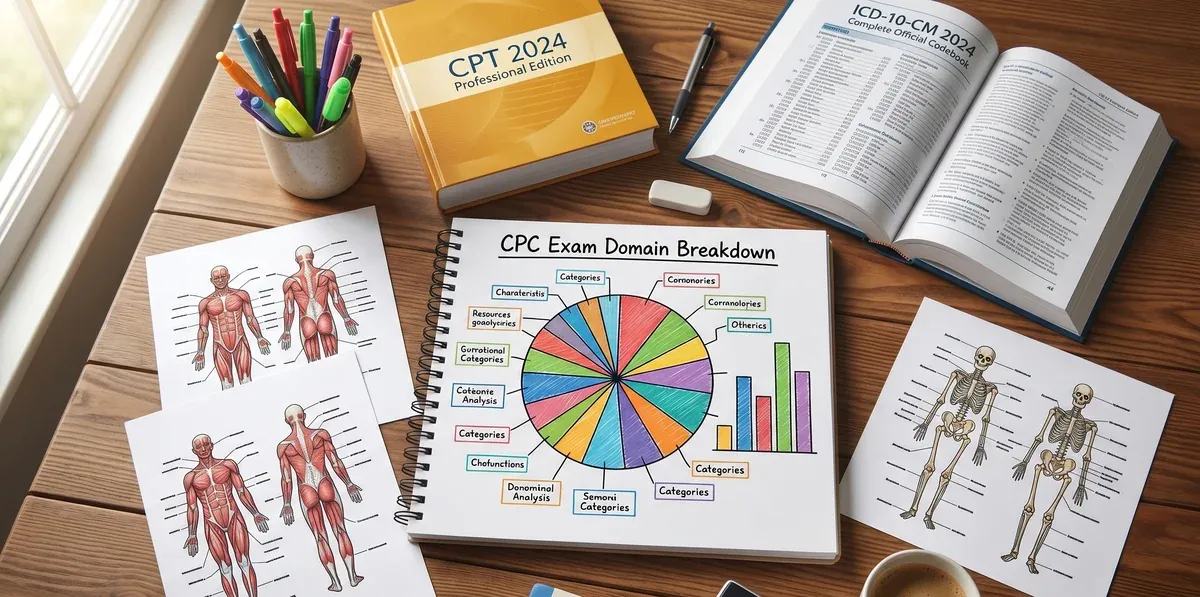
CPC Exam Body Systems: All 17 Domains Explained (2026 Study Priority Guide)
The CPC exam covers 17 medical coding domains. Here is which body systems carry the most questions, how to prioritize your study time, and what the exam actually tests in each section.

How to Study for the CPC Exam with Kids: Realistic Tips for Busy Parents
You do not need 4-hour study blocks to pass the CPC exam. Here is a realistic study plan built for parents: 15-30 minute sessions, micro-drills, and a 4-month schedule that works.
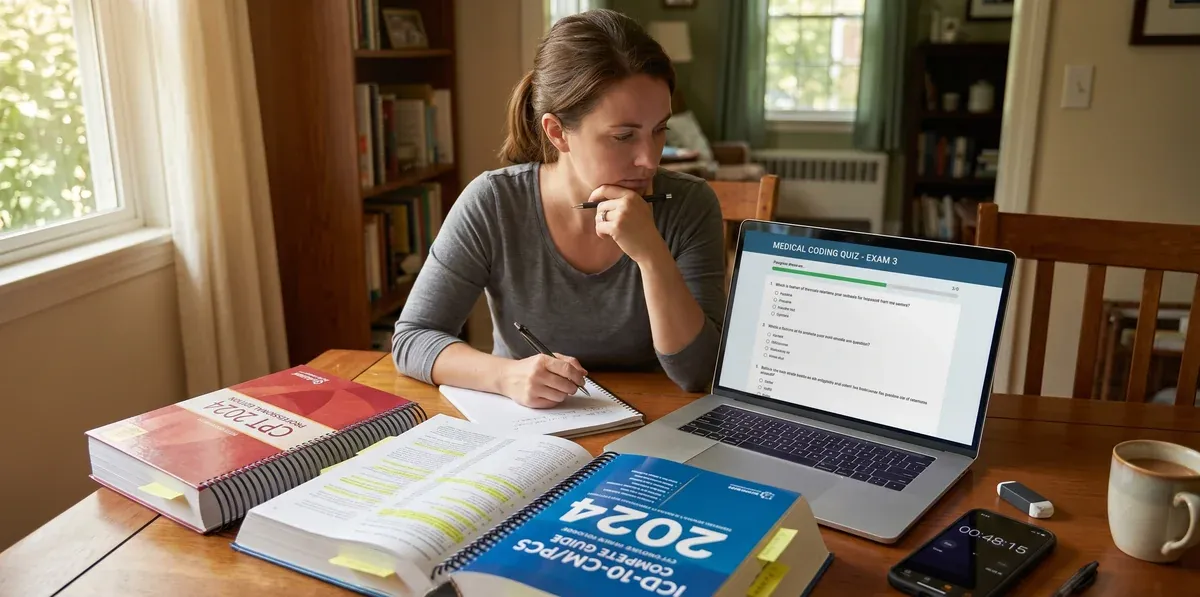
CPC Mock Exam Guide: How to Use Practice Exams to Pass on Your First Try
Taking a CPC mock exam is not the same as being ready for one. Here is how to run your mock exams to actually prepare: timing, review strategy, score interpretation, and when you are ready.
Ready to practice?
Test your CPC knowledge with real exam-style questions. Free to start.
Start Blitz Mode