Medical Coding Career Change: The Guide to $60k+ Remote Work (2026)
By CPCPrep Team ·

Medical Coding Career Change: What It Actually Takes in 2026
Is Medical Coding a Realistic Career Change?
Let’s be real about this: medical coding works as a career change for a lot of people, but not for the reasons most articles say.
It is not easy. It is not passive income. And it is not a path where you study for a few weeks and land a $60k remote job. But it is absolutely doable, and for the right person with the right expectations, it holds up.
Who makes this switch (real profiles)
The people who actually complete this transition tend to fit a few patterns. Former nurses who want desk work and no more night shifts. Administrative staff already working in clinics who want to formalize what they have been doing informally. Stay-at-home parents returning to work after years away. People who are done with retail or hospitality and want a job they can do from a real desk, with standard hours, without standing on their feet for eight hours.
What they share: high tolerance for detail work, comfort learning from manuals, and the ability to sit with ambiguity. Medical documentation is often unclear. Coders deal with that every day.
Do you need medical experience?
No. But you do need to learn anatomy and medical terminology from scratch, and that is real work. The CPC exam expects you to understand body systems, operative procedures, and diagnostic language well enough to translate physician notes into standardized codes.
Most career changers pick this up through their exam prep. It takes 3-6 months of consistent study. The AAPC recommends 2 years of coding experience before sitting the CPC exam, but that recommendation is not a requirement. Many candidates sit with zero prior experience. Passing rates for first-time candidates are around 50%, so preparation matters.
The honest timeline: 6-18 months start to employed
If you know what to expect, you will know what your focus needs to be. Plan 6 months to study and pass the CPC exam. Then plan another 3-6 months to land your first role. Total: 9-18 months from zero to employed.
Some people are faster. Some take longer. It depends on how many hours per week you can put in, and how quickly the job search goes in your market.
What a Medical Coder Actually Does All Day
Here is what actually happens on the job, not the version from the career change blogs.
The work itself (not the glamorized version)
You receive medical documentation: physician notes, operative reports, discharge summaries. You read them, determine what was diagnosed and what procedures were performed, and translate that into standardized codes from three main code sets: ICD-10-CM for diagnoses, CPT for procedures, and HCPCS for supplies and services.
Then you submit those codes on claims to insurance payers. When payers deny claims, you review the denial, determine whether the denial is correct or incorrect, and either correct the code or write an appeal.
That is the job. It is knowledge work. Not creative work. The satisfaction comes from getting the code right, from understanding a complex operative report, from catching a documentation error before it becomes a denial. If that sounds appealing, good. If it sounds tedious, pay attention to that.
Remote work reality in 2026
Most remote coding setups are: VPN access into the employer’s EHR system, a headset for team calls, and a dual-monitor setup. You work independently for most of the day. Team meetings are brief and infrequent.
Over 65% of coding roles are remote or hybrid in 2026. That number has been growing since 2020 and has stabilized at roughly this level. The work is genuinely location-independent once you have the access credentials and the skills.
One thing most remote job descriptions do not say clearly: you are expected to meet daily productivity targets. A typical target is 80-100 charts per day for inpatient coding, or 25-40 operative reports for outpatient. That is real pressure. Coders who are not yet fast enough get performance managed.
How to Get a CPC Certification: The Path
Here is where it gets practical: there are four steps, and the order matters.
Step 1: AAPC membership ($222/year)
The AAPC (American Academy of Professional Coders) is the organization that runs the CPC exam. You need to be a member to register for the exam and to access most study materials at the member price.
Membership costs $222 per year. This is the starting cost. Budget it as the first line item.
Step 2: Study (self-study vs. course)
You have two real options.
Self-study: AAPC’s official CPC Study Guide costs around $150. Pair it with their online practice exams ($200-$250). Total cost around $350-$400 on top of membership. Expect 150-300 hours of study time spread over 3-6 months.
AAPC’s online course: $1,099-$1,499 depending on the bundle. Includes structured curriculum, video lessons, and a practice exam. Useful if you need structure and accountability. Some employers recognize AAPC training completion, which helps slightly with entry-level hiring.
The self-study route is financially smarter if you are disciplined. The course is worth it if you have tried self-study before and know you need external structure.
A third option that many career changers overlook: community college medical coding programs. These run $800-$2,000, often include the AAPC exam prep in the curriculum, and sometimes qualify for FAFSA. Worth checking your local options before committing to a higher-cost online course.
Step 3: The exam ($399-$499)
The CPC exam is 5 hours and 40 minutes, 100 multiple-choice questions, and it is open-book. The exam fee is $399 for AAPC members. Non-members pay $499.
Open-book, but that is not the same as easy. The questions are scenario-based. You are given a clinical scenario and asked to select the correct code. Knowing where to look in your code books is part of the skill. Coders who are not fast with their books run out of time.
The passing score is 70%. Roughly 1 in 2 first-time candidates does not pass. A second attempt costs $299.
Don’t overthink it. Look at the scenario as it is presented. The question is asking about what is documented, not what might have been clinically appropriate.
Step 4: First job search
This is the part of the path that most guides skip over.
After passing the CPC, new coders get the designation “CPC-A” (apprentice) until they complete 2 years of coding experience. Some employers treat the A as a red flag. Others do not care. Small physician groups and medical billing outsourcing companies tend to be the most flexible on experience requirements for entry-level hires.
Entry-level remote roles are harder to land than entry-level in-person roles. Most remote positions list 1-2 years of experience as a requirement. The path for many people: get certified, take an entry-level role at a hospital or clinic (sometimes in-person), build 12 months of experience, then apply to remote positions from a stronger position.
It takes time, but it is well worth it. The patience required in the job search phase is part of the process.
Salary Reality: Entry Level vs Experienced
Focus on the principles. That is really what they are testing with every job title you see on a job board: not just what you can code today, but where you can go with this credential over the next 5 years.
First year expectations ($35k-$45k)
Entry-level coders in their first year typically earn $35,000-$42,000. In high-cost-of-living markets (California, New York, Massachusetts), that floor is closer to $40,000-$45,000. In lower-cost markets, it can be as low as $32,000.
That is the real number. Some job postings advertise higher for entry-level roles, but those typically require the CPC plus 1-2 years of experience in a specific specialty.
With 2-3 years + CPC ($55k-$70k)
After 2-3 years with a CPC certification, salaries in the $55,000-$70,000 range are realistic for remote roles. The jump from year 1 to year 3 is significant because you have crossed the experience threshold that most remote employers actually require.
ZipRecruiter’s 2025 salary data puts the national median for remote medical coders at $58,400, with the top 25% at $68,000+.
Specialization path ($70k-$85k)
This is the long game. Coders who specialize in cardiology, oncology, orthopedics, or inpatient facility coding earn $70,000-$85,000 after 5+ years. Specialty certifications from AAPC (CPC-P, COC, specialty-specific certifications) push compensation into this range.
The breadth is enormous on the way in, but specialization is where the ceiling gets higher.
Which Employers Actually Hire Remote Coders
Answer the easier questions first when you are starting your job search: start with employers known to hire entry-level or recently certified coders before targeting the large health systems that require 3+ years of experience.
Companies that regularly post remote medical coding roles:
- Optum (UnitedHealth Group): large volume of remote coding positions, tends to require 1+ year experience
- HCA Healthcare: hospital system with consistent remote coding openings
- R1 RCM: revenue cycle management company, mix of entry-level and experienced roles
- Nthrive: coding and revenue cycle services, often flexible on remote for experienced coders
- Ensemble Health Partners: regularly posts remote inpatient and outpatient roles
- Ciox Health (now Datavant): remote coding and HIM roles
- Maxim Health: staffing-side, good for contract coding work while building experience
- LifePoint Health: regional health system with remote coding openings
Also worth targeting: specialty physician groups in gastroenterology, cardiology, and orthopedics. These practices often use third-party billing companies, and those billing companies frequently hire newly certified coders at lower cost than large health systems. Less name recognition, but more flexible on the experience requirement.
Medical billing outsourcing companies (also called RCM companies) are a consistent source of entry-level work. They handle billing for many physician practices, move faster than hospital HR departments, and often have a more structured onboarding for new coders.
The Hardest Part (That Nobody Tells You)
Here is what most guides won’t tell you: the first job is harder to land than the exam.
Most entry-level remote positions require 1-2 years of experience. That requirement is on most job postings you will find. It means that even after passing the CPC, you are not automatically qualified for the remote roles you want.
This is not a reason to avoid medical coding as a career. It is a reason to prepare differently. The practical path: plan for an in-person or hybrid entry-level role for the first 12 months after certification, then move to remote once you have the experience on your resume.
Some employers do hire CPC-certified coders with no prior experience directly into remote roles. These are smaller physician groups and coding companies, and they are out there. But they are not the majority of postings, and competing for them is harder.
The second thing nobody says clearly: the first-year salary is real. $35,000-$42,000 for year one is not a rumor. Medical coding is a long game. The $60,000+ remote salary is a year 3-4 outcome for most people, not a year 1 outcome.
You can go in with confidence. But only if you prepare the right way, and only if you go in with a realistic timeline.
Ready to start?
If you are serious about the CPC exam, the fastest way to know whether you are ready is to test your baseline now.
Take the free CPC readiness quiz: 5 minutes →
Related reading:
- Medical coding salary: what remote coders actually earn
- How much does CPC certification cost? Full breakdown
- Can you become a medical coder with no medical background?
- CPC exam prep guide: how to study and pass
- Remote medical coding jobs: which employers hire and what they pay
- Medical coding vs billing: which career path is right for you
Sources:
- BLS Occupational Outlook Handbook: Medical Records and Health Information Specialists
- ZipRecruiter: Remote Medical Coder Salary Data
- AAPC: CPC Certification
- Research.com: How to Become a Medical Coder
Sources & References
Frequently Asked Questions
Can I become a medical coder without a medical background? ▼
Yes. Medical experience helps with the learning curve, but it is not required. Most career changers learn anatomy and medical terminology through their CPC exam prep in 3-6 months. The AAPC recommends 2 years of coding experience before sitting the exam, but that is a recommendation, not a gate. You can sit and pass the CPC with zero prior clinical experience.
How long does it take to transition into medical coding? ▼
Most career changers complete CPC certification in 3-6 months of study, then spend another 3-6 months landing their first role. Total realistic timeline: 9-18 months from zero to employed. Some people are faster. Some take longer. It depends on how much time you can put in each week, and how quickly entry-level hiring is moving in your target market.
Can you work from home as a medical coder? ▼
Yes, but usually not on day one. Most remote positions require 1-2 years of experience or CPC certification. The path for most people: get certified, take an entry-level role (sometimes in-person), build 1 year of experience, then go remote. Over 65% of coding roles include a remote option, so the destination is realistic. The timeline to get there is 1-2 years post-certification for most people.
How much does a medical coder make in the first year? ▼
Entry-level coders typically earn $35,000-$42,000 in year one. With a CPC certification and 2-3 years of experience, that climbs to $55,000-$70,000. Specialized coders in cardiology, oncology, or inpatient facility coding reach $75,000-$85,000 with 5+ years and specialty certifications.
Is medical coding in demand in 2026? ▼
Yes. The Bureau of Labor Statistics projects 9% job growth for medical records and health information roles through 2033, faster than the average for all occupations. Remote work options and an aging population keep demand steady. The number of claims that need to be coded does not shrink when the economy slows down.
Test Your Knowledge
5 quick questions on this topic.
Related Articles
Medical Coding vs Medical Billing: CPC vs CPB : Which Should You Choose?
Medical coding and medical billing are different jobs with different certifications. Here is what each role actually does, what it pays, and which path makes more sense for you in 2026.

Can You Become a Medical Coder with No Medical Background? (2026 Reality Check)
Yes, you can become a medical coder without a medical degree or clinical experience. Here is what it actually takes: the CPC path, the timeline, and what most guides won't tell you.
Medical Coding Certification Cost in 2026: True Breakdown (Bootcamp vs Self-Study)
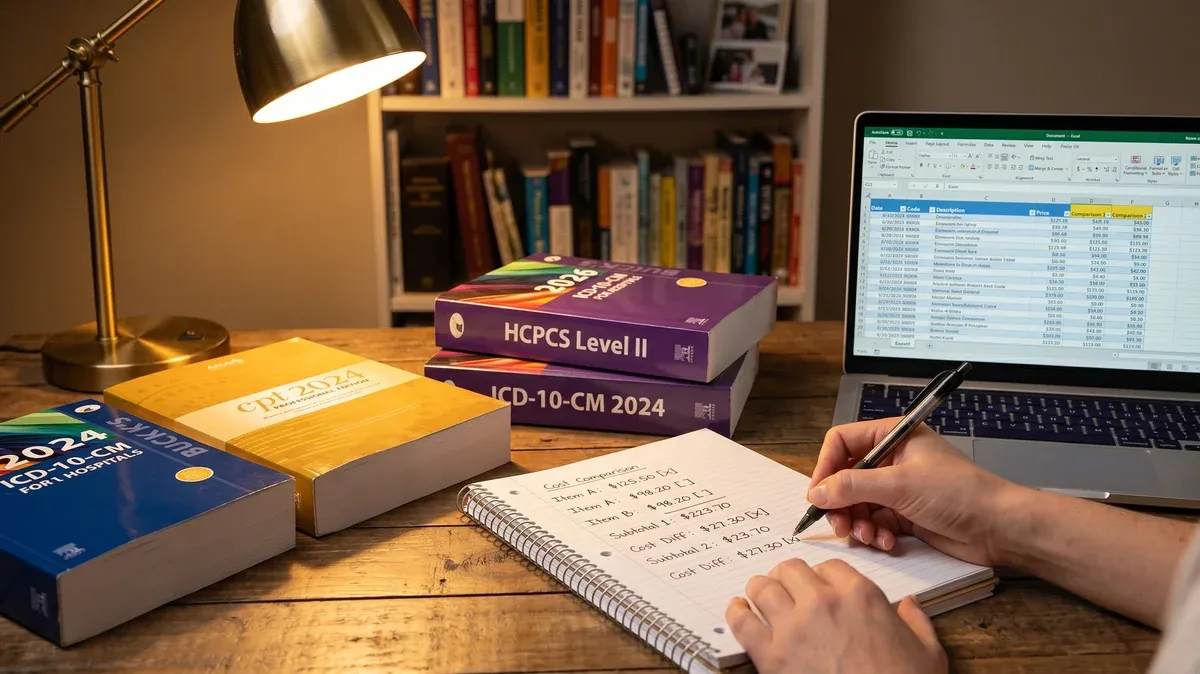
How much does it actually cost to get CPC certified? AAPC membership, exam fees, study tools, and bootcamp costs compared. Plus: the ROI math that makes self-study the obvious choice for most.
Ready to practice?
Test your CPC knowledge with real exam-style questions. Free to start.
Start Blitz Mode