CPC Exam Body Systems: All 17 Domains Explained (2026 Study Priority Guide)
By CPCPrep Team ·
CPC Exam Body Systems: All 17 Domains Explained (2026 Study Priority Guide)
The 17 CPC exam domains at a glance
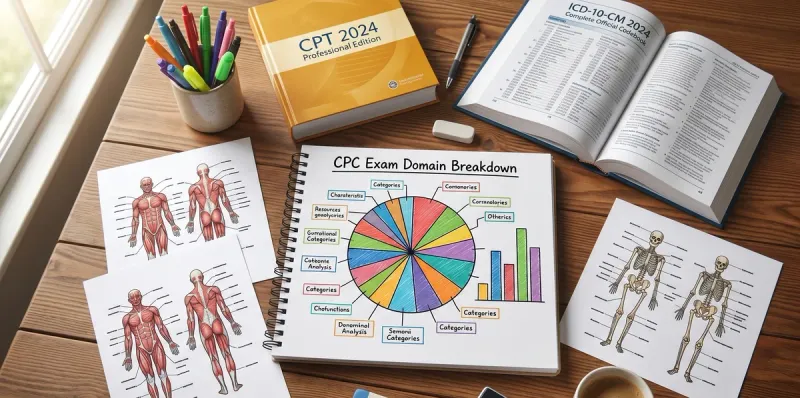
The AAPC builds the CPC exam around 17 coding domains. Some are standalone (Anesthesia, Radiology, Pathology). Most are surgical specialties organized by body system.
| Domain | Priority | Key topics |
|---|---|---|
| Evaluation and Management | HIGH | 99202-99499, MDM, time-based |
| Anesthesia | MEDIUM | base units, time units, qualifying circumstances |
| Surgery: Integumentary | HIGH | excision codes 11400-11646, repair, lesion removal |
| Surgery: Musculoskeletal | HIGH | fracture care, joint injection, arthroscopy |
| Surgery: Respiratory | MEDIUM | bronchoscopy, thoracoscopy, sinusoscopy |
| Surgery: Cardiovascular | MEDIUM | catheterization, stent, pacemaker |
| Surgery: Digestive | MEDIUM | colonoscopy, laparoscopy, hernia |
| Surgery: Urinary | MEDIUM | cystoscopy, lithotripsy, nephrectomy |
| Surgery: Male/Female Genital | LOW-MEDIUM | hysterectomy, obstetric codes |
| Surgery: Nervous System | LOW-MEDIUM | nerve block, spine surgery |
| Surgery: Eye and Ear | LOW | cataract, tympanoplasty |
| Radiology | MEDIUM | global vs professional component, modifier 26 |
| Pathology and Laboratory | LOW-MEDIUM | panel codes, pathology report coding |
| Medicine | MEDIUM | infusions, vaccinations, E/M-adjacent services |
| HCPCS Level II | LOW-MEDIUM | J codes (drugs), L codes (orthotics), DME |
| ICD-10-CM | HIGH | guidelines, conventions, chapter-specific rules |
| Coding Guidelines / CPT Conventions | HIGH | modifiers, NCCI, global package |
AAPC does not publish an exact question count per domain. Based on community reports, Surgery sections collectively account for roughly 50-60% of questions. E/M, ICD-10-CM, and modifiers are the next biggest categories.
High-priority domains (highest question count)
Surgery: Integumentary system
This domain covers more than skin-deep cuts. You need excision codes (11400-11646), shave removal, destruction, and repair. Repair breaks into three types: simple, intermediate, complex. Each has different coding rules.
The margin calculation matters. Excised diameter is lesion size plus the margin. Surgeons remove more tissue than the lesion itself, and the code follows the total excised diameter, not the visible lesion. Adjacent tissue transfer and skin graft basics also appear.
Surgery: Musculoskeletal system
Fracture care is the anchor here. Know closed vs open reduction, with or without manipulation. Know what “without manipulation” actually means in CPT. Cast and strapping codes are separate from the fracture care codes.
Joint injections appear often, arthroscopy less so but still present. The global surgical package for fracture care is tested regularly: what is included, what you can bill separately.
Evaluation and Management (E/M)
The 2021 E/M guideline changes still appear heavily on the 2026 exam. Two pathways exist: MDM-based and time-based. Both are testable.
For MDM, know the three elements (problems, data, risk) and how to count complexity at each level. New vs established patients. Place of service differences: office, hospital, ED. These questions appear in almost every scenario-based question, not just the E/M section.
ICD-10-CM diagnosis coding
The exam does not test code memorization. It tests guideline application. Excludes1 vs Excludes2, includes notes, combination codes. Chapter-specific rules are a reliable source of questions: Chapter 15 (pregnancy), Chapter 19 (injury sequencing), Chapter 20 (external causes).
If you are unsure, the Official Guidelines for Coding and Reporting run about 150 pages. You do not need to memorize them. You need to be able to navigate them quickly and recognize which guideline applies to a given scenario.
Medium-priority domains
Cardiovascular, Digestive, Urinary, Respiratory
These four surgical specialties collectively represent a significant chunk of the exam. Cardiovascular: catheterization, stent placement, pacemaker codes. Digestive: colonoscopy vs sigmoidoscopy distinctions, laparoscopic hernia repair. Urinary: cystoscopy, lithotripsy, nephrectomy. Respiratory: bronchoscopy, thoracoscopy.
The common thread across all four: understanding whether a procedure is diagnostic or therapeutic changes the code. That distinction appears constantly.
Modifiers and HCPCS
Modifiers are not a separate domain on the exam, but they run through every domain. The most frequently tested: 25, 51, 59, 26/TC, 22, LT/RT, 50. Know when each applies and when NCCI edits come into play.
HCPCS Level II covers drugs (J codes), orthotics (L codes), and durable medical equipment. Less heavily tested than CPT but not ignorable.
Radiology and Pathology
Radiology questions often center on the global vs professional component split. Modifier 26 (professional component) and modifier TC (technical component) appear in scenarios where the physician reads a study but does not own the equipment. Know when to use each.
Pathology is lower volume. Panel codes, surgical pathology levels, cytology vs histology. The questions are not difficult if you have spent time here: they are just niche.
Lower-priority domains (but don’t skip them)
Surgery: Male/Female Genital and Surgery: Nervous System sit in a middle zone. They are not the highest question count, but they are not skippable either. Hysterectomy approaches (vaginal vs abdominal vs laparoscopic), obstetric coding basics, nerve blocks, spinal fusion coding.
Surgery: Eye and Ear is genuinely lower volume. Cataract extraction, tympanoplasty, cochlear implant. If time is short in your final two weeks, this is where you can spend less time. Just do not skip it entirely.
How to prioritize your study time
If you know what to expect, you’ll know what your focus needs to be.
Spend the last 4 weeks before your exam this way: 50% on your weakest domains (by mock exam domain score), 30% on E/M and ICD-10-CM (they touch every section of the exam), 20% on timed full-mock practice. Do not spend 4 weeks reviewing material you already know well. That feels productive and isn’t.
The mistake most candidates make: studying evenly across all 17 domains. You have limited time. A domain where you are already scoring 80% does not need the same attention as one where you are scoring 50%. Run a practice test, pull your domain scores, and study toward your weakest numbers.
You can get 30 questions wrong and still pass. Keep that in mind when you are deep in a weak domain and it feels overwhelming. You do not need a perfect score. You need 70 questions right.
See your weakest domains now: take the free 20-question practice test and get a domain breakdown.
Sources: AAPC CPC Exam Overview, AAPC CPC exam blueprint 2026, CCO.us CPC exam domain breakdown.
Related: CPC Exam Prep Guide | CPC Exam Study Strategy | Free CPC Practice Test | CPT Excision Guidelines | ICD-10 Diagnosis Sequencing | Modifier 25 and 51 Guide
Sources & References
Frequently Asked Questions
Is the CPC exam multiple choice in 2026? ▼
Yes. All 100 questions are multiple choice with 4 answer options. Some questions include brief operative reports or patient encounter descriptions as the scenario.
How hard is it to pass the AAPC CPC exam? ▼
Moderately difficult. The challenge is the breadth (17 domains) and the time pressure (2.4 minutes per question, open-book). The passing score is 70%: you can miss 30 questions and still pass.
Who makes more money, CPC or CCS? ▼
CCS (Certified Coding Specialist, AHIMA) typically pays slightly more in hospital inpatient settings ($65K-$80K). CPC dominates outpatient and physician practice ($55K-$75K). If you plan to work in a hospital coding unit, CCS may offer higher earning potential long-term.
How many questions are in each domain on the CPC exam? ▼
AAPC does not publish an exact question count per domain. Based on community reports, Surgery sections collectively account for approximately 50-60% of questions. E/M, ICD-10-CM, and modifiers are the next largest categories.
Test Your Knowledge
5 quick questions on this topic.
Related Articles

How to Study for the CPC Exam with Kids: Realistic Tips for Busy Parents
You do not need 4-hour study blocks to pass the CPC exam. Here is a realistic study plan built for parents: 15-30 minute sessions, micro-drills, and a 4-month schedule that works.
CPC Mock Exam Guide: How to Use Practice Exams to Pass on Your First Try
Taking a CPC mock exam is not the same as being ready for one. Here is how to run your mock exams to actually prepare: timing, review strategy, score interpretation, and when you are ready.

CPC Exam Pass Rate 2026: Is It Hard? Real Statistics and How to Prepare
AAPC does not publish an official CPC exam pass rate. Here is what the medical coding community actually says, plus the factors that separate candidates who pass from those who do not.
Ready to practice?
Test your CPC knowledge with real exam-style questions. Free to start.
Start Blitz Mode