CPC Exam Prep: Complete Guide to Passing on Your First Attempt (2026)
By CPCPrep Team ·

CPC Exam Prep: Complete Guide to Passing on Your First Attempt (2026)
Quick Answer: The CPC (Certified Professional Coder) exam is a 100-question, 4-hour open-book test administered by AAPC. It covers medical terminology, anatomy, CPT coding, ICD-10-CM, HCPCS, and compliance guidelines. First-attempt pass rates are estimated at 50 to 65%. All-in cost runs $620 to $720 for non-members. The fastest path to passing is a structured 6-month plan that starts with terminology and anatomy, builds into CPT rules and modifiers, and finishes with timed full mock exams.
What Is the CPC Exam? (Format, Domains, Cost in 2026)
The Certified Professional Coder credential is issued by the American Academy of Professional Coders (AAPC) and is the industry benchmark for medical coding in physician offices and outpatient settings. Passing the CPC is typically the first requirement for entry-level coding positions and remote work opportunities in the field.
Exam Format: 100 Questions, 4 Hours, Open Book
The CPC exam consists of 100 multiple-choice questions. You have 4 hours to complete it. The exam is open book: you may bring your CPT, ICD-10-CM, and HCPCS codebooks, tabbed and annotated however you like.
Here’s what that open-book format actually means: you don’t need to memorize thousands of codes. But it doesn’t mean easy. Four hours sounds like plenty of time until you’re on question 60 and you’ve spent 8 minutes on one complex operative report. That’s when candidates realize they haven’t prepared for the right thing.
The exam is offered in person at Prometric testing centers or as a remote proctored exam through AAPC’s online portal. You receive your score at the end of the session.
17 Body Systems and Domains Tested
The CPC exam is structured around medical specialties and body systems rather than a single topic list. AAPC’s exam blueprint covers 17 areas including:
- Evaluation and Management (E/M) coding
- Anesthesia
- Surgery: Integumentary, Musculoskeletal, Respiratory, Cardiovascular, Digestive, Urinary, Reproductive, Nervous System
- Radiology
- Pathology and Laboratory
- Medicine
- ICD-10-CM diagnosis coding
- HCPCS Level II
- Medical terminology and anatomy (tested throughout, not as a standalone section)
- Compliance and regulatory guidelines (HIPAA, CMS, correct coding initiative)
Surgical coding and E/M carry the most weight, but weak performance in any cluster of domains can pull you below 70%. You can’t afford to skip entire sections hoping they won’t show up.
True Cost Breakdown (Membership + Exam + Materials)
The CPC exam is not cheap. Here is what to realistically budget:
| Item | Cost |
|---|---|
| AAPC membership (required) | $222/year |
| Exam fee (member rate) | $399 |
| Exam fee (non-member rate) | $499 |
| CPT codebook (current year) | $100-$130 |
| ICD-10-CM codebook | $80-$100 |
| HCPCS Level II codebook | $60-$80 |
| Optional: official study guide | $149-$189 |
Minimum all-in cost (member, no study guide, using free resources): roughly $700-$750.
If your employer is sponsoring your certification, get the commitment in writing before you invest. If you are self-funding, budget $800 to $900 to be safe and include a potential retake fee ($199 for members).
How Hard Is the CPC Exam? (Pass Rate and Real Data)
Here’s the real number: roughly 1 in 2 first-time candidates does not pass. AAPC doesn’t publish an official rate, but the data that circulates in the coding community is consistent.
First-Attempt Pass Rate: 50-65% (AAPC Does Not Publish an Official Rate)
AAPC does not release an official first-attempt pass rate. What circulates in the coding community, including on AAPC’s own training FAQ, puts the number somewhere between 50 and 65% on the first try.
Open Exam Prep’s 2026 analysis and CCI Training both suggest it’s closer to 50-55% for candidates with no prior coding experience. Candidates coming from clinical or billing backgrounds pass at higher rates, around 65-70%.
This is not a reason to avoid the exam. It’s a reason to prepare differently than the average candidate.
Most Common Reasons for Failure
Coders who retake the exam tend to fail for the same reasons. They’re not randomly distributed. Here are the ones that come up again and again:
1. Passive studying instead of active recall. Reading the CPT guidelines is not the same as applying them under time pressure. Most candidates who fail have read the material thoroughly but have not coded enough practice questions to build speed and decision-making instincts.
2. Weak E/M coding skills. Evaluation and Management coding is one of the most heavily tested areas and one of the most rule-heavy. The 2021 E/M changes (and subsequent updates) added complexity. Candidates who underweight E/M practice consistently underperform in this section.
3. Not practicing with a clock. 100 questions in 240 minutes means 2.4 minutes per question on average. A mini op report where each answer has four codes? That’s easily 4 to 5 minutes. That time has to come from somewhere. Candidates who never timed their practice sessions are genuinely shocked by the pacing on exam day. By then, it’s too late to fix.
4. Not tabbing the codebooks efficiently. The open-book format is only an advantage if you can find information fast. Candidates who go into the exam with un-tabbed books, or books tabbed according to someone else’s system, lose minutes they cannot afford.
5. Skipping the ICD-10-CM Official Guidelines. The guidelines document is freely downloadable from CMS and is one of the most tested reference sources on the exam. Most candidates know the codes exist but have never read the sequencing rules, the chapter-specific guidelines, or the Excludes1 and Excludes2 conventions. Examiners know this. Questions are specifically written to test whether you understand the rules behind the codes, not just whether you can look up a code.
6. Going deep on one resource and calling it studying. Reading a study guide is homework. Timed practice is exam prep. They’re not the same thing. Candidates who treat them as equivalent consistently underperform, regardless of how many hours they log.
Am I Ready to Start Studying?
Before building a 6-month study plan, it helps to know where you are starting from. A quick readiness check can tell you whether you need to budget more time on anatomy and terminology before moving into CPT coding rules.
Take the free CPCPrep readiness quiz to get a baseline score across the three main knowledge areas. It takes about 8 minutes and gives you a breakdown by domain so you can front-load your weak areas.
Start the readiness quiz on CPCPrep (free, no account required)
The 6-Month Study Plan (Week by Week)
This plan assumes you are starting with limited coding experience, studying 8 to 10 hours per week, and targeting a first-attempt pass. Adjust the phase lengths based on your readiness quiz results.
Weeks 1-4: Medical Terminology and Anatomy (Blitz Mode)
Do not rush this phase. Every coding error that happens later in the exam traces back to a misread term or a misunderstood anatomical site.
What to cover:
- Root words, prefixes, and suffixes (epigastric, nephro-, cardio-, etc.)
- Anatomy for the 17 body systems tested: at minimum, learn the structures that appear most frequently in CPT surgery subsections
- Directional terms and planes of the body
- Surgical terminology (incision, excision, anastomosis, ligation, debridement)
How to study: Use active recall flashcard methods rather than reading lists. The CPCPrep Blitz mode is built for this: you swipe through terminology cards with spaced repetition, which builds retention faster than re-reading the same glossary.
Target: 30 minutes of Blitz mode per day (roughly 150-200 cards) plus one timed coding exercise on a simple case (E/M note or minor procedure) per week.
Milestone check: By week 4, you should be able to read a short operative note and identify the anatomical structures, the type of procedure, and the approach without looking up terminology. If you cannot, extend this phase by 1 to 2 weeks.
Weeks 5-12: CPT Rules and Modifiers (Sniper Mode)
This is the highest-density phase of your preparation. CPT coding rules, especially modifiers, are where most candidates get confused and where exam questions are concentrated.
What to cover:
- CPT codebook structure: sections, subsections, notes, parenthetical instructions
- Modifiers: 22, 25, 26, 51, 52, 57, 58, 59, 62, 66, 78, 79, TC (and when not to use each)
- Correct Coding Initiative (CCI) edits: what qualifies as a bundled service
- Global surgical package: what is and is not included
- E/M coding: 2021 guidelines for office visits (medical decision-making vs. time-based)
- Anesthesia: base units, time units, qualifying circumstances
- Radiology: technical vs. professional component, supervision and interpretation
How to study: Move into scenario-based practice. The CPCPrep Sniper mode presents rule-conflict dilemmas: two codes where you must decide whether a modifier applies, whether services are separately billable, or which code most accurately represents the encounter. This mirrors the actual exam question format.
Aim for 2 to 3 Sniper sessions per week (20 to 30 questions each) plus one full chapter review from the CPT guidelines.
Milestone check: By week 12, you should be able to code a moderate-complexity E/M visit (with a procedure performed the same day) correctly, apply the appropriate modifier, and explain why in under 3 minutes.
Weeks 13-20: ICD-10-CM and Bundling Rules
Diagnosis coding is tested throughout the CPC exam, not in an isolated section. Every surgery and procedure question requires accurate diagnosis code selection.
What to cover:
- ICD-10-CM Official Guidelines for Coding and Reporting (the full document: read it)
- Sequencing rules: principal diagnosis, first-listed diagnosis, additional codes
- Combination codes vs. multiple codes
- Signs and symptoms vs. definitive diagnoses
- Chronic conditions and their complications
- Injury coding: trauma, poisoning, adverse effects, underdosing
- Obstetrics coding (Chapter 15 guidelines)
- Neoplasm table: behavior column logic, primary vs. secondary, morphology codes
- HCPCS Level II: when to use instead of CPT, J codes, A codes, E codes
How to study: Practice coding from actual clinical documentation. AAPC’s online practice exams include operative reports and office notes. For ICD-10-CM specifically, create your own “scenario cards”: take a diagnosis description, find the correct code, then create a variant (complication present, additional condition mentioned) and re-code it.
Milestone check: By week 20, you should be able to correctly sequence a primary diagnosis, a secondary chronic condition, and an injury code from a single clinical note without checking the sequencing guidelines every time.
Weeks 21-24: Full Mock Exams Under Timed Conditions
This phase is non-negotiable. If you skip timed full-length practice, you are not prepared for the exam.
Week 21 to 22: Two full 100-question mock exams, strictly timed at 4 hours each. Do not pause. Do not look at your notes mid-session. Treat each one as the real exam.
After each mock exam:
- Review every wrong answer. Do not just note the correct code. Understand the rule that explains why your answer was wrong.
- Track which domains your errors cluster in. If you missed 6 ICD-10-CM questions, go back to weeks 13-20 material.
- Note which questions you got right but spent too long on. Speed is as important as accuracy.
Week 23: Targeted remediation. Focus only on your two weakest domains based on mock exam results. Use Sniper mode for rule-conflict review and re-code the sections where you made errors.
Week 24: One final full mock exam, then a light review of modifiers and ICD-10-CM guidelines. Do not try to learn new material the week before the exam. Consolidate what you know.
Milestone check: You are ready when you are consistently scoring 72 to 75% or above on full mock exams under timed conditions. A score of 70% on a practice exam is not a comfortable margin for the real thing.
Best CPC Study Tools in 2026 (Honest Comparison)
There are a lot of CPC study products. Most of them are fine. What matters is how you combine them. Here’s what each one is actually good for.
AAPC Official Study Guide
Cost: $149-$189 (purchased separately from the exam)
The AAPC Official CPC Study Guide is the closest thing to a guaranteed content match with the exam. It is written by the same organization that writes the test, which means the terminology, question framing, and code set coverage align with what you will actually see.
Strengths: Content accuracy, exam-aligned practice questions, structured chapter order that follows the exam blueprint.
Where it falls short: It tells you what to study but doesn’t build the active recall or decision-making speed you need under the clock. Candidates who rely on it exclusively often know the material and still run out of time.
Best for: Content review and understanding the exam blueprint. Not a standalone prep tool.
Mometrix and Third-Party Study Guides
Cost: $30-$100 (book), $60-$200 (online access)
Mometrix, AMCI, and similar third-party guide publishers offer lower-cost alternatives. The quality varies significantly. Some third-party guides are well-researched and current. Others lag behind annual CPT updates or contain errors that can create bad habits.
Strengths: Price point. Some candidates find third-party guides more readable than the AAPC guide.
Weaknesses: Content accuracy is not guaranteed to match the current year’s exam. Always check the publication date and verify that the CPT and ICD-10-CM content reflects the current code set.
Best for: Supplemental reading and additional practice questions after you have established a solid base with official materials.
Gamified Practice Tools (CPCPrep)
Cost: Free (Blitz mode and practice questions)
CPCPrep is built around the two problems that cause most first-attempt failures: weak terminology recall and slow decision-making on rule-conflict questions.
Blitz mode uses spaced repetition on medical terminology, anatomy, and coding concepts. You swipe through cards daily, and the algorithm resurfaces terms you are missing. The goal is to make terminology lookup in your codebooks feel automatic rather than effortful.
Sniper mode presents rule dilemmas: two valid-looking codes where you must apply modifier rules, bundling logic, or guideline exceptions to find the right answer. This builds the decision-making muscle you need under time pressure.
Best for: Daily active recall practice, terminology mastery, and modifier/bundling scenario training. Use alongside your codebooks and official study guide, not as a replacement for them.
The Blitz and Sniper modes are free. Full mock exam access (100 questions, timed) is available with a paid subscription.
No single tool covers everything, and that’s fine. They’re not supposed to. The combination that works: annotated codebooks (tabbed by week 16), scenario-based practice in Sniper mode, and at least two full timed mock exams before the real thing. Candidates who use three or more complementary methods pass at significantly higher rates than those who go deep on one resource and ignore the others. For a detailed side-by-side comparison of all the major prep tools, see the CPC study material comparison.
The Open-Book Timing Strategy Most Candidates Ignore
Most candidates know the exam is open book. Fewer have thought through what that actually means under time pressure.
Here’s what works:
Tab your books before the exam, not the day before. Effective tabbing takes 3 to 4 hours per book and should be done by week 16 of your study plan, so you are actually navigating with your tabs during mock exams. By exam day, your hand should reach for the right section automatically.
Know the guideline pages cold. The CPT guidelines at the front of each section and the ICD-10-CM Official Guidelines are open to you during the exam. But if you are hunting for the correct guideline under time pressure for the first time, you will lose. Read the guidelines actively during your study plan and mark the ones that appear most frequently in practice questions.
Build a personal cheat sheet of “always-check” scenarios. During your study phase, keep a running list of the scenarios where you consistently make errors. This is not the guidelines themselves but your specific weak points: “When modifier 59 vs. XE/XS/XP/XU: always check the CCI edits table first.” Review this list before the exam.
Use a two-pass strategy on exam day. On the first pass, answer every question you can within 90 seconds. Mark the complex operative reports and lengthy scenario questions to return to. Complete the first pass in roughly 90 minutes. Use the remaining time for marked questions. This prevents a single hard question from eating into time you need for 10 easier questions later in the exam.
When you’re stuck, guess and move on. Wrong and unanswered score the same: zero. If you’ve spent 5 minutes on one question and have 30 left to go, make your best call and keep moving. Don’t leave questions blank. With 5 minutes remaining, go fill in everything you skipped: pick one of the two answers you narrowed it down to and mark it. Most candidates who fail have unanswered questions at the end, not wrong ones.
Sources: AAPC CPC Certification | AAPC Pass Score FAQ | AAPC Graduate Pass Rate | CCI Training CPC Requirements | Open Exam Prep Pass Rate 2026
Sources & References
Frequently Asked Questions
How long is the CPC exam? ▼
The CPC exam is 4 hours long and contains 100 multiple-choice questions. You may bring approved reference books and your own tabs into the testing room. Time management is critical: you have an average of 2.4 minutes per question, but operative reports and bundling scenarios can take 4-5 minutes each if you are not practiced.
What score do you need to pass the CPC exam? ▼
You need a score of 70% or higher to pass, which means answering at least 70 out of 100 questions correctly. AAPC does not publish an official curve or adjustment. According to AAPC's own support documentation, the passing threshold has remained at 70% for several exam cycles.
Is the CPC exam hard? ▼
It depends on your preparation. The exam is not designed to trick you; it tests whether you can apply coding guidelines accurately under time pressure with your books open. Candidates who struggle most are those who memorize codes without understanding the underlying rules. If you build real decision-making skills, the open-book format works in your favor.
What books are allowed in the CPC exam? ▼
AAPC allows the current-year CPT codebook, ICD-10-CM codebook, and HCPCS Level II codebook. You may tab and annotate your books before the exam. Digital devices, phones, and internet access are not permitted. Knowing where to find information in your books quickly is as important as knowing the content.
How long should I study for the CPC exam? ▼
Most successful first-attempt candidates study for 4 to 6 months, averaging 8 to 12 hours per week. If you already have a background in medical terminology or clinical work, you may be able to compress this to 3 months. If you are starting from zero, plan for 6 months and do not rush the anatomy and terminology phase.
Is medical billing and coding worth it in 2026? ▼
Yes, especially for remote work. The BLS projects steady demand for health information technologists through 2032. Certified medical coders earn a national median around $48,000-$58,000 per year, with experienced CPC holders at larger practices or specialties earning significantly more. The CPC credential is the most recognized certification for physician office coding, and remote positions are widely available.
Test Your Knowledge
5 quick questions on this topic.
Related Articles
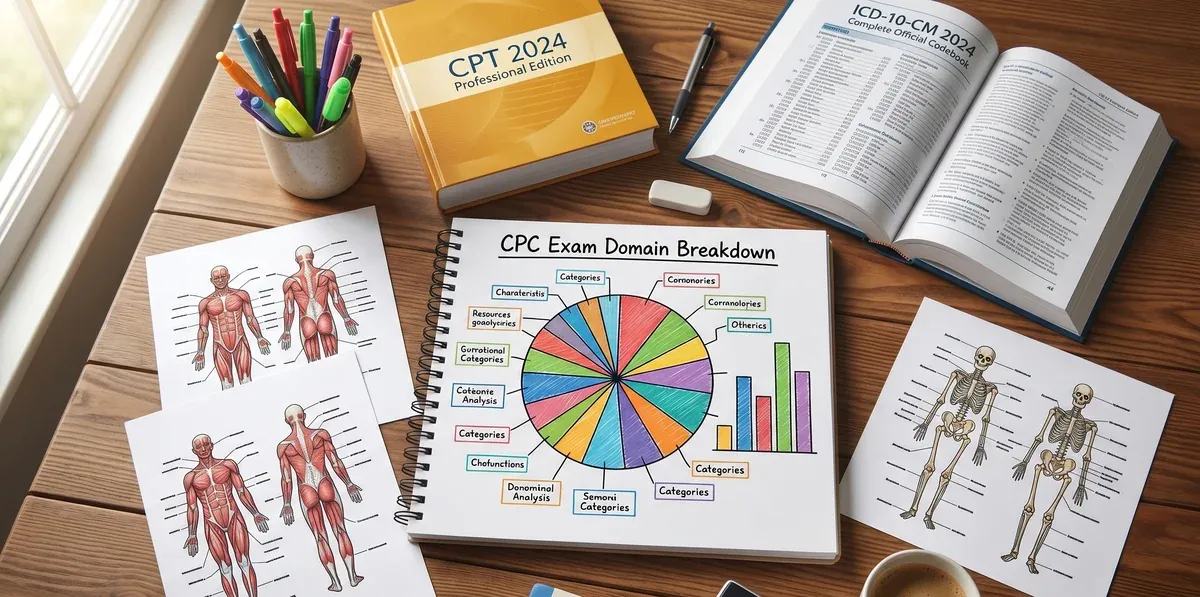
CPC Exam Body Systems: All 17 Domains Explained (2026 Study Priority Guide)
The CPC exam covers 17 medical coding domains. Here is which body systems carry the most questions, how to prioritize your study time, and what the exam actually tests in each section.
How to Study for the CPC Exam with Kids: Realistic Tips for Busy Parents
You do not need 4-hour study blocks to pass the CPC exam. Here is a realistic study plan built for parents: 15-30 minute sessions, micro-drills, and a 4-month schedule that works.
CPC Mock Exam Guide: How to Use Practice Exams to Pass on Your First Try
Taking a CPC mock exam is not the same as being ready for one. Here is how to run your mock exams to actually prepare: timing, review strategy, score interpretation, and when you are ready.
Ready to practice?
Test your CPC knowledge with real exam-style questions. Free to start.
Start Blitz Mode